| |
Hares - There are two species of hares in Alaska,
both of which turn white in the winter. The snowshoe, or
varying hare, is the most common and widespread of these. It is
distributed over the state except for the lower Kuskokwim Delta, the
Alaska Peninsula, and the area north of the Brooks Range. It is sparsely
distributed along the southeastern mainland except for major river
deltas. The Alaskan hare, also called the tundra hare, populates
much of the western coast of Alaska, including the Alaska Peninsula, but
has a spotty distribution along the Arctic coast and the north slope of
the Brooks Range.
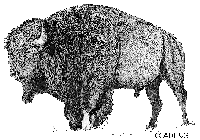 Bison - which shaped the lifestyle of the Plains Indians and
figured prominently in American history before they were brought to near
extinction, were transplanted to Alaska from Montana in 1928. While
bison were the most common large land mammal in Alaska thousands of
years ago, all of Alaska's existing wild bison came from 20 animals
released near Delta Junction. Natural emigration and transplants have
now created additional herds at Copper River, Chitina River, and
Farewell. Small domestic herds are located at Healy, near Kodiak, and on
Popov Island. There were approximately 700 wild bison in the state in
mid-1985. Bison - which shaped the lifestyle of the Plains Indians and
figured prominently in American history before they were brought to near
extinction, were transplanted to Alaska from Montana in 1928. While
bison were the most common large land mammal in Alaska thousands of
years ago, all of Alaska's existing wild bison came from 20 animals
released near Delta Junction. Natural emigration and transplants have
now created additional herds at Copper River, Chitina River, and
Farewell. Small domestic herds are located at Healy, near Kodiak, and on
Popov Island. There were approximately 700 wild bison in the state in
mid-1985.
Black bears - are the most abundant and widely
distributed of the three species of North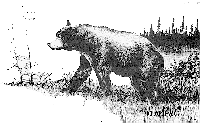 American bears. They have been recorded in all states except Hawaii. In
Alaska, black bears occur over most of the forested areas of the state.
They are not found on the Seward Peninsula, on the Yukon-Kuskokwim
Delta, or north of the Brooks Range. They also are absent from some of
the large islands of the Gulf of Alaska, notably Kodiak, Montague,
Hinchinbrook and others, and from the Alaska Peninsula beyond the area
of Lake Iliamma. In Southeast Alaska, black bears occupy most islands
with the exceptions of Admiralty, Baranof, Chichagof, and Kruzof. These
are inhabited by brown bears. Both species occur on the southeastern
mainland. Black bears are most often associated with forests, but
depending on the season of the year, they may be found from sea level to
alpine areas.
American bears. They have been recorded in all states except Hawaii. In
Alaska, black bears occur over most of the forested areas of the state.
They are not found on the Seward Peninsula, on the Yukon-Kuskokwim
Delta, or north of the Brooks Range. They also are absent from some of
the large islands of the Gulf of Alaska, notably Kodiak, Montague,
Hinchinbrook and others, and from the Alaska Peninsula beyond the area
of Lake Iliamma. In Southeast Alaska, black bears occupy most islands
with the exceptions of Admiralty, Baranof, Chichagof, and Kruzof. These
are inhabited by brown bears. Both species occur on the southeastern
mainland. Black bears are most often associated with forests, but
depending on the season of the year, they may be found from sea level to
alpine areas.
Brown bears - occur throughout Alaska except on t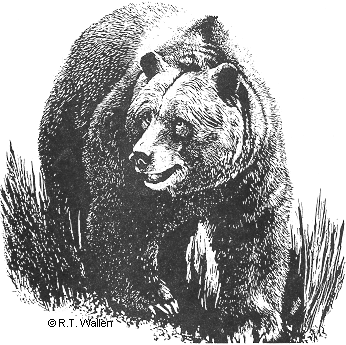 he
islands south of Frederick Sound in southeastern Alaska, the islands
west of Unimak in the Aleutian Chain, and the islands of the Bering Sea.
They also occur in Canada, Asia, Europe, and in limited numbers in a few
western states. Brown bears are very much a part of the Alaska scene and
are a favorite topic with most hunters, hikers, photographers, and
fishers. Formerly, taxonomists listed brown and grizzly bears as
separate species. Technically, brown and grizzly bears are classified as
the same species. Brown bears on Kodiak Island are classified as a
distinct subspecies from those on the mainland because they are
genetically and physically isolated. The shape of their skulls also
differs slightly. The term “brown bear” is commonly used to refer to the
members of this species found in coastal areas where salmon is the
primary food source. Brown bears found inland and in northern habitats
are often called “grizzlies.” In this paper, brown bear is used to refer
to all members of Ursus arctos. he
islands south of Frederick Sound in southeastern Alaska, the islands
west of Unimak in the Aleutian Chain, and the islands of the Bering Sea.
They also occur in Canada, Asia, Europe, and in limited numbers in a few
western states. Brown bears are very much a part of the Alaska scene and
are a favorite topic with most hunters, hikers, photographers, and
fishers. Formerly, taxonomists listed brown and grizzly bears as
separate species. Technically, brown and grizzly bears are classified as
the same species. Brown bears on Kodiak Island are classified as a
distinct subspecies from those on the mainland because they are
genetically and physically isolated. The shape of their skulls also
differs slightly. The term “brown bear” is commonly used to refer to the
members of this species found in coastal areas where salmon is the
primary food source. Brown bears found inland and in northern habitats
are often called “grizzlies.” In this paper, brown bear is used to refer
to all members of Ursus arctos.
Caribou - live in the arctic tundra, mountain
tundra, and northern forest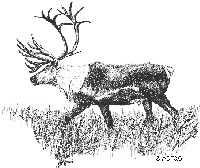 s
of North America, Russia, and Scandinavia. The world population is about
5 million. Caribou in Alaska are distributed in 32 herds (or
populations). A herd uses a calving area that is separate from the
calving areas of other herds, but different herds may mix together on
winter ranges. In Europe, caribou are called reindeer, but in Alaska and
Canada only the domestic forms are called reindeer. All caribou and
reindeer throughout the world are considered to be the same species, but
there are 7 subspecies: barrenground, Svalbard, European, Finnish forest
reindeer, Greenland, woodland and Peary. Alaska has only the
barren-ground subspecies, but in Canada the barren-ground, woodland, and
Peary subspecies are found. s
of North America, Russia, and Scandinavia. The world population is about
5 million. Caribou in Alaska are distributed in 32 herds (or
populations). A herd uses a calving area that is separate from the
calving areas of other herds, but different herds may mix together on
winter ranges. In Europe, caribou are called reindeer, but in Alaska and
Canada only the domestic forms are called reindeer. All caribou and
reindeer throughout the world are considered to be the same species, but
there are 7 subspecies: barrenground, Svalbard, European, Finnish forest
reindeer, Greenland, woodland and Peary. Alaska has only the
barren-ground subspecies, but in Canada the barren-ground, woodland, and
Peary subspecies are found.
Dall Sheep - inhabit the mountain ranges of
Alaska. Dall sheep are found in relatively dry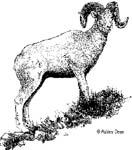 country and frequent a special combination of open alpine ridges,
meadows, and steep slopes with extremely rugged "escape terrain" in the
immediate vicinity. They use the ridges, meadows, and steep slopes for
feeding and resting. When danger approaches they flee to the rocks and
crags to elude pursuers. They are generally high country animals but
sometimes occur in rocky gorges below timberline in Alaska. Male Dall
sheep are called rams. They are distinguished by massive curling horns.
The females, called ewes, have shorter, more slender, slightly curved
horns. Rams resemble ewes until they are about 3 years old. After that,
continued horn growth makes them easily recognizable. Horns grow
steadily during spring, summer, and early fall. In late fall or winter
horn growth slows and eventually ceases. This is probably a result of
changes in body chemistry during the rut, or breeding season. This
start-and-stop growth of horns results in a pattern of rings called
annuli which are spaced along the length of the horn. These annual rings
can be distinguished from the other rough corrugations on the sheep’s
horns, and age can be accurately determined by counting the annuli. Dall
rams as old as 16 years have been killed by hunters, and ewes have been
known to reach the age of 19 years. Most generally, a 12-year-old sheep
is considered very old. As rams mature, their horns form a circle when
seen from the side. Ram horns reach half a circle in about two or three
years, three-quarters of a circle in four to five years, and a full
circle or "curl" in seven to eight years.
country and frequent a special combination of open alpine ridges,
meadows, and steep slopes with extremely rugged "escape terrain" in the
immediate vicinity. They use the ridges, meadows, and steep slopes for
feeding and resting. When danger approaches they flee to the rocks and
crags to elude pursuers. They are generally high country animals but
sometimes occur in rocky gorges below timberline in Alaska. Male Dall
sheep are called rams. They are distinguished by massive curling horns.
The females, called ewes, have shorter, more slender, slightly curved
horns. Rams resemble ewes until they are about 3 years old. After that,
continued horn growth makes them easily recognizable. Horns grow
steadily during spring, summer, and early fall. In late fall or winter
horn growth slows and eventually ceases. This is probably a result of
changes in body chemistry during the rut, or breeding season. This
start-and-stop growth of horns results in a pattern of rings called
annuli which are spaced along the length of the horn. These annual rings
can be distinguished from the other rough corrugations on the sheep’s
horns, and age can be accurately determined by counting the annuli. Dall
rams as old as 16 years have been killed by hunters, and ewes have been
known to reach the age of 19 years. Most generally, a 12-year-old sheep
is considered very old. As rams mature, their horns form a circle when
seen from the side. Ram horns reach half a circle in about two or three
years, three-quarters of a circle in four to five years, and a full
circle or "curl" in seven to eight years.
Moose - is the world's largest member of the deer
f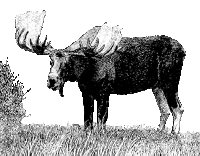 amily.
The Alaska race is the largest of all the moose. Moose are generally
associated with northern forests in North America, Europe, and Russia.
In Europe they are called "elk." In Alaska, they occur in suitable
habitat from the Stikine River in the Panhandle to the Colville River on
the Arctic Slope. They are most abundant in recently burned areas that
contain willow and birch shrubs, on timberline plateaus, and along the
major rivers of Southcentral and Interior Alaska. Moose are long-legged
and heavy bodied with a drooping nose, a "bell" or dewlap under the
chin, and a small tail. Males in prime condition weigh from 1,200 to
1,600 pounds (542-725 kg). Adult females weigh 800 to 1,300 pounds
(364-591 kg). Only the bulls have antlers. amily.
The Alaska race is the largest of all the moose. Moose are generally
associated with northern forests in North America, Europe, and Russia.
In Europe they are called "elk." In Alaska, they occur in suitable
habitat from the Stikine River in the Panhandle to the Colville River on
the Arctic Slope. They are most abundant in recently burned areas that
contain willow and birch shrubs, on timberline plateaus, and along the
major rivers of Southcentral and Interior Alaska. Moose are long-legged
and heavy bodied with a drooping nose, a "bell" or dewlap under the
chin, and a small tail. Males in prime condition weigh from 1,200 to
1,600 pounds (542-725 kg). Adult females weigh 800 to 1,300 pounds
(364-591 kg). Only the bulls have antlers. |